Setup and Organization
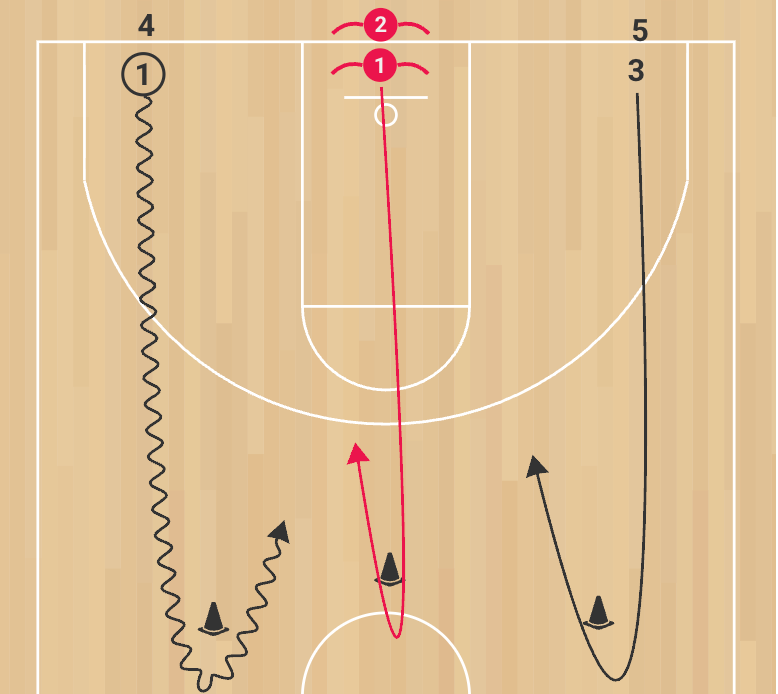
Divide the team into two groups: one offensive, one defensive. The defensive players line up single-file under the basket, while two offensive lines are formed on the baseline inside the three-point line, one on each side. Three cones are set up at half-court, with the middle cone aligned for the defender and the outer cones for the offensive players. On the coach’s signal, one defender and two offensive players sprint around their cones, with the ball starting in the hands of one offensive player. After circling the cones, play becomes live in a 2-on-1 coming back to the same basket.
Step-by-Step Progression
1. The first defender and two offensive players sprint around their assigned cones at half-court.
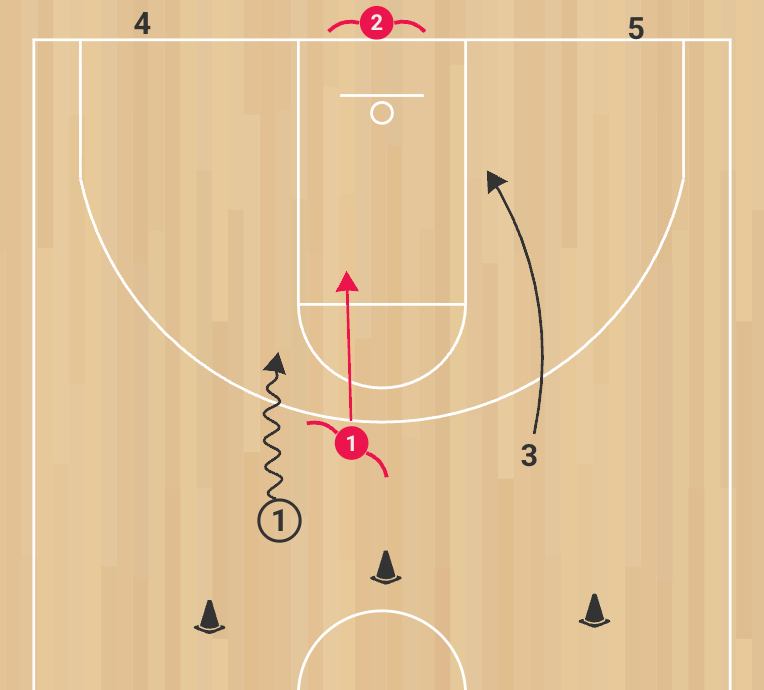
2. The offensive player with the ball attacks with a live dribble, looking to force the defender to commit.
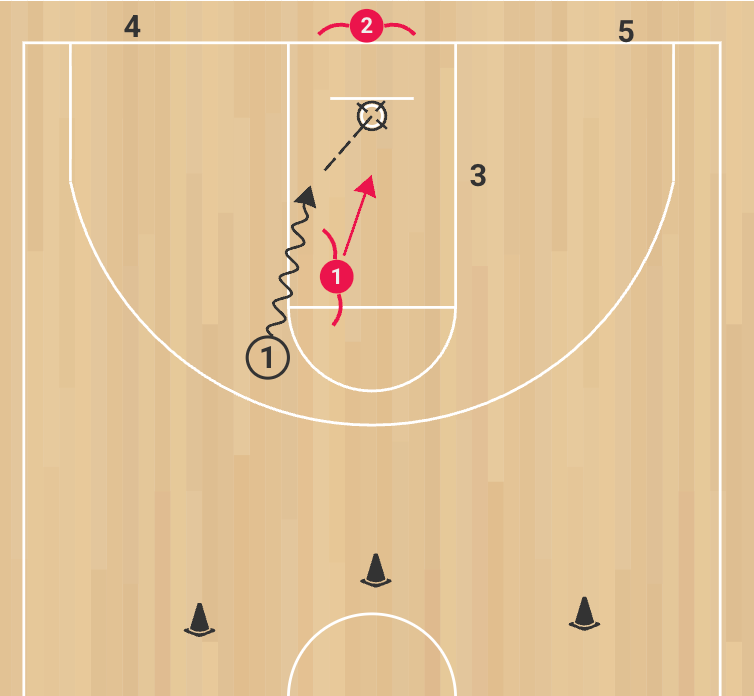
3. Offensively, the goal is to score within one pass or less—attack hard, break the defense, and only pass if it leads directly to an uncontested layup.
4. The off-ball offensive player stays wide and ready for a dump-off.
5. The defender sprints into the play, protects the paint, uses stunts and active hands, and avoids overcommitting to either player. The defensive goal is to delay the offense, force multiple passes, or push the offense into a tough shot.
6. After the possession ends, reset with the next players in line.
Scoring
Defensive stops are the scoring metric. A stop qualifies as a defensive rebound, a forced turnover, or a missed shot rebounded by the defense. In addition, if the defender forces two or more passes before the offense scores, it also counts as a stop. Each stop is one point. Any defensive foul resets the group’s score to zero. Rotate offense and defense after three minutes.
Coaching Points
Offensively, stress attacking to score, not overpassing. The ball handler must look to draw the defender fully before considering a pass, and any pass must create a clean layup opportunity. Defensively, emphasize stunting and buying time—force the ball handler to hesitate, contest without fouling, and avoid giving up direct layups. Communication and discipline are essential to simulate real transition situations.
Variations
Add progressions by starting the drill full court, allowing the offense to build speed, or permitting a trailing defender to recover after a few seconds. You can also restrict the offense to only one dribble to stress passing efficiency, or add shot value scoring (layups = 1, jump shots = 2) for additional competition.